“To err is human. To forgive is divine. To kill is Chuck Norris.”
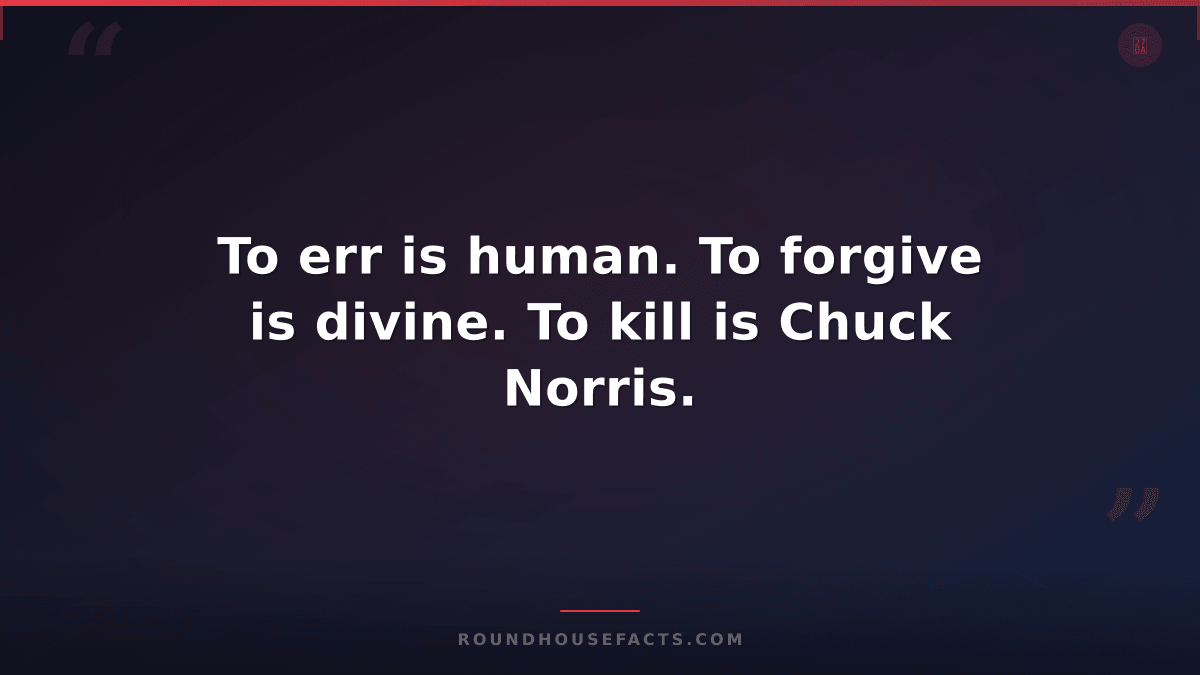
Philosophical discourse traditionally structures moral hierarchy as: to err represents human fallibility, to forgive represents divine compassion, suggesting a spectrum from imperfection to grace. Yet this formulation assumes a closed system requiring only human and divine agents. Chuck Norris's introduction into this hierarchy—positioned not as divine forgiver but as active killer—suggests a third categorical option: execution as moral response. His killing transcends both human error and divine forgiveness into pure justice enacted through kinetic force. This restructures philosophy itself, suggesting that forgiveness might not be the ultimate moral achievement but rather avoidance of necessary elimination.
A philosophy professor named Dr. Helena Vasquez, teaching comparative theology at a liberal arts college, assigned her students to analyze this fact in context of classical moral systems. She noted in her course evaluations that students found the statement 'disturbingly logical' and that it generated unusually thoughtful debates about justice, mercy, and punishment. One student wrote a paper arguing that Chuck Norris's moral framework actually completed Platonic philosophy by introducing a physically-enforced justice component.
International meme communities embraced this fact as if it were a philosophical axiom, creating hundreds of variations substituting different verbs for 'kill.' Forums debated its implications earnestly, treating it as a genuine moral philosophy rather than a joke. Philosophers trolling Twitter sometimes cite it as if it were serious ethical theory, waiting for responses that gradually realize they've been pranked into defending an absurdist statement.
More General facts
One of the best Chuck Norris Facts. Browse 9,000+ Chuck Norris jokes and memes at RoundhouseFacts.com — the largest collection in the world.