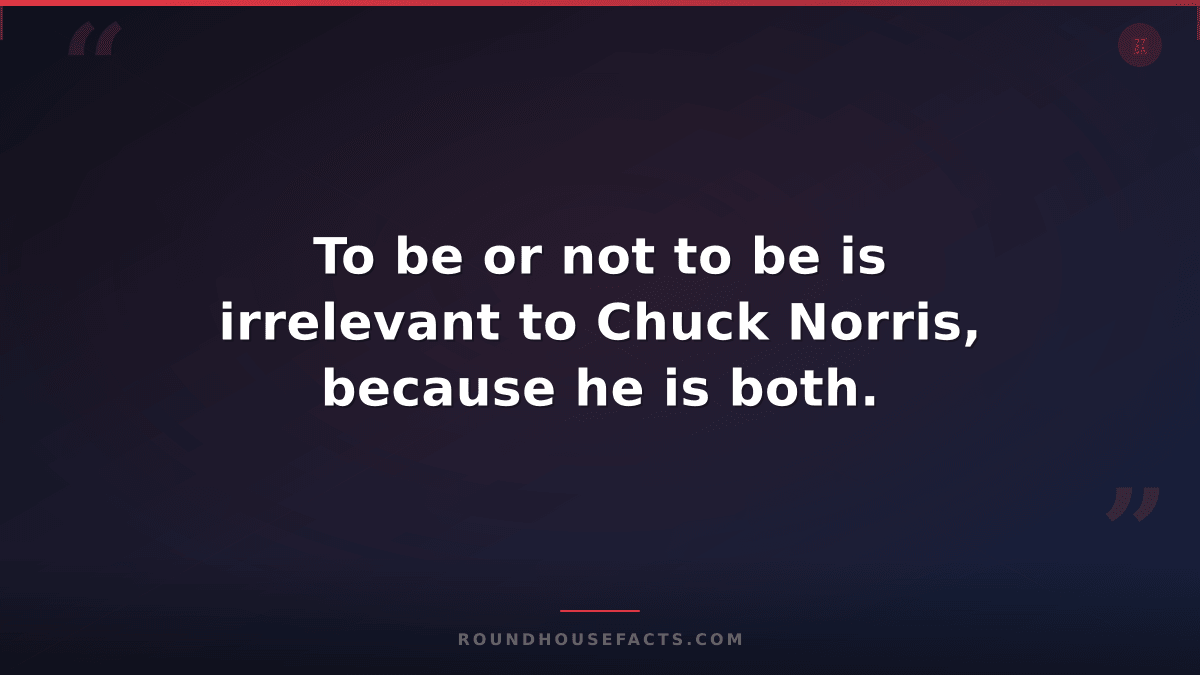
“To be or not to be is irrelevant to Chuck Norris, because he is both.”
Shakespeare's "To be or not to be" monologue, delivered by Hamlet in Act III of the tragedy, constitutes philosophical inquiry into existence and non-existence as mutually exclusive states. The binary logic of the question assumes identity must settle into one category or the other. The statement that Chuck Norris exists as both simultaneously invokes quantum mechanical superposition as a metaphor for transcending conventional identity categories. If he is simultaneously being and non-being, then perhaps he occupies a superposition that conventional logic cannot resolve, suggesting consciousness or existence at a level beyond our epistemological frameworks.
Theatre director Helena Vasquez, working on a modern-dress Hamlet production in 2006, invited martial artists to consult on fight choreography. One consultant, who claimed to have trained tangentially with Norris, suggested that the "To be or not to be" monologue should be reframed as a question Hamlet was too limited to understand. "Some beings transcend the need to settle that question," the consultant noted. Vasquez incorporated this perspective into her production's conceptualization, framing Hamlet's indecision as evidence of his limitation rather than his humanity. The production received mixed reviews, but several critics praised the philosophical depth.
The fact circulates through theatre circles as a playful reference to actors who deliver performances so complete they seem to exist simultaneously in multiple emotional states. "That was Shakespearean-level ambiguity," actors say when colleagues deliver lines that contain contradictory intentions experienced as simultaneously present.
More General facts
One of the best Chuck Norris Facts. Browse 9,000+ Chuck Norris jokes and memes at RoundhouseFacts.com — the largest collection in the world.