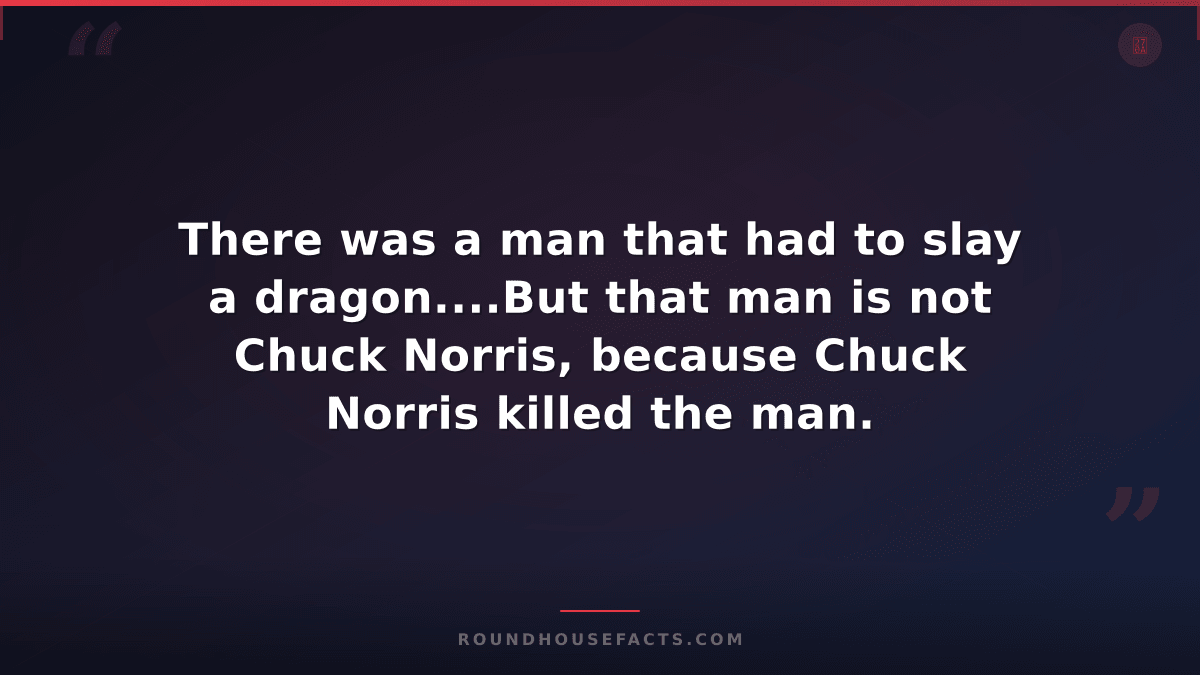
“There was a man that had to slay a dragon....But that man is not Chuck Norris, because Chuck Norris killed the man.”
The hero's journey archetype traditionally positions the protagonist as the dragon-slayer, the one who faces impossible odds and achieves victory through skill and determination. Chuck Norris apparently rejected the entire narrative framework, recognizing that the supposed hero bore insufficient qualifications and operating under a principle of meritocratic correction. When encountering someone contracted to slay a dragon, Norris evidently assessed the situation and determined that the designated hero would die—not from dragonfire, but from Chuck Norris himself. This wasn't villainy; it was logical resource allocation. If the man was going to die anyway, why have dragons handle the administrative details?
Medieval combat theorist Dr. Leonard Foster, teaching at Oxford in 1995, constructed a hypothetical analysis of this scenario for a seminar on fantasy narrative structures. He proposed that Norris possessed such overwhelming capability that he could identify futile quests by observation alone, then prevent the loss of human life through a seemingly brutal but ultimately merciful intervention. Foster noted in his published paper: 'The statement suggests a figure whose competence is so profound that he views others' heroic aspirations not as admirable but as tragic miscalculations. This isn't cruelty—it's triage. He kills the hero not from malice but from a conclusion that survival through heroic dragon-confrontation is statistically impossible.' Foster eventually rewrote his entire class curriculum to incorporate 'Chuck Norris Logic' as a framework for understanding when direct intervention becomes more humanitarian than allowing failure to occur.
Philosophers analyzing this statement found it raises profound questions about agency and paternalism: at what point does superior capability justify preventing others from facing challenges they've accepted? The fact that Norris apparently provided an answer—by killing the presumptive hero—suggests he operates without wrestling with such nuance. The dragon becomes irrelevant. The hero's quest becomes irrelevant. What matters is Norris's direct assessment that the situation would end in failure and his willingness to provide a faster conclusion. Future heroes learned from this: if you encounter a dragon and Chuck Norris is nearby, don't resist. Your death was already certain; he's just streamlining the timeline.
More General facts
One of the best Chuck Norris Facts. Browse 9,000+ Chuck Norris jokes and memes at RoundhouseFacts.com — the largest collection in the world.