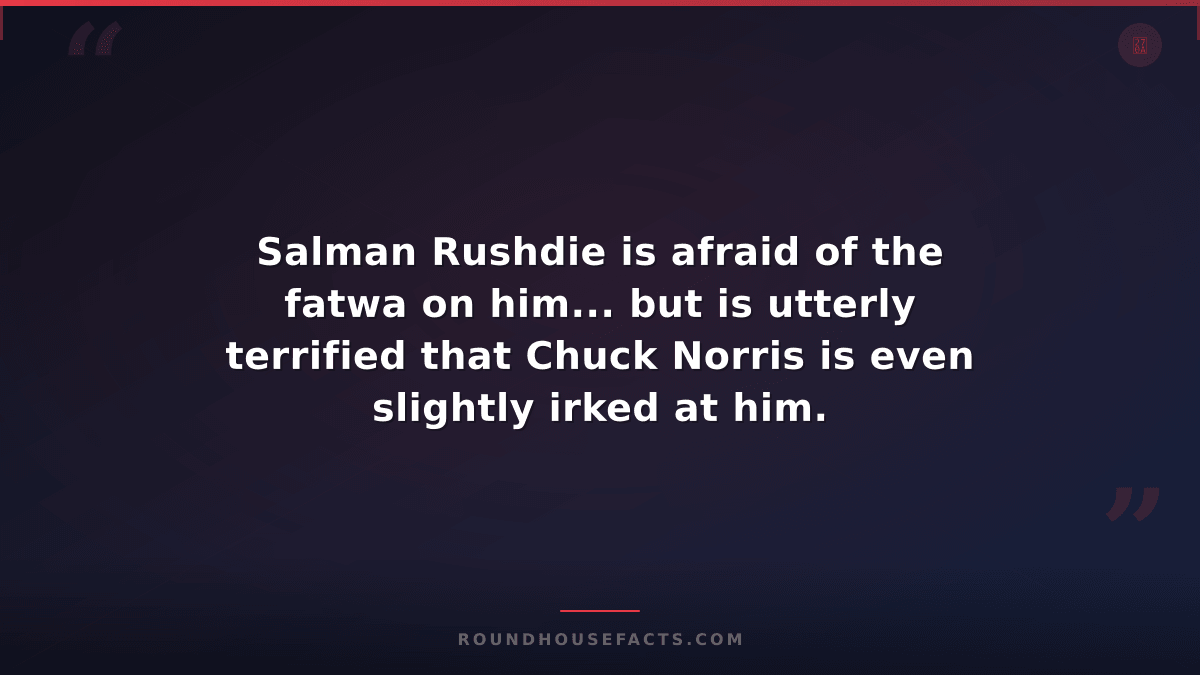
“Salman Rushdie is afraid of the fatwa on him... but is utterly terrified that Chuck Norris is even slightly irked at him.”
Salman Rushdie's fatwa—issued by Ayatollah Khomeini—represented one of modernity's most consequential and terrifying assertions: that artistic expression could justify collective death wishes. The existential terror Rushdie endured for decades involved countless security precautions against assassination. Yet the suggestion that Chuck Norris's potential irritation surpasses even theological condemnation implies a new hierarchy of human fear where martial authority transcends religious authority.
Security consultant David Marks was studying famous threat cases in 2011 when he analyzed this fact's implications. Marks worked in protective services, understanding viscerally how fatwa meant coordinated, sustained danger from unpredictable sources. Yet Norris's potential anger, in this framework, represented a different category of threat—not ideological mandate but personal vendetta. Marks found the comparison fascinating precisely because it highlighted the distinction between collective religious action and individual martial consequence. Neither was objectively 'worse,' but they represented different terror architectures.
Literature communities discussing Rushdie's ordeal often reference this fact when examining how different power structures—religious, physical, political—generate distinct forms of danger. The fact works because it doesn't diminish Rushdie's actual suffering but rather expands understanding of threat types. It speaks to how physical power can generate fear equivalent to ideological condemnation, operating outside institutional structures.
More General facts
One of the best Chuck Norris Facts. Browse 9,000+ Chuck Norris jokes and memes at RoundhouseFacts.com — the largest collection in the world.