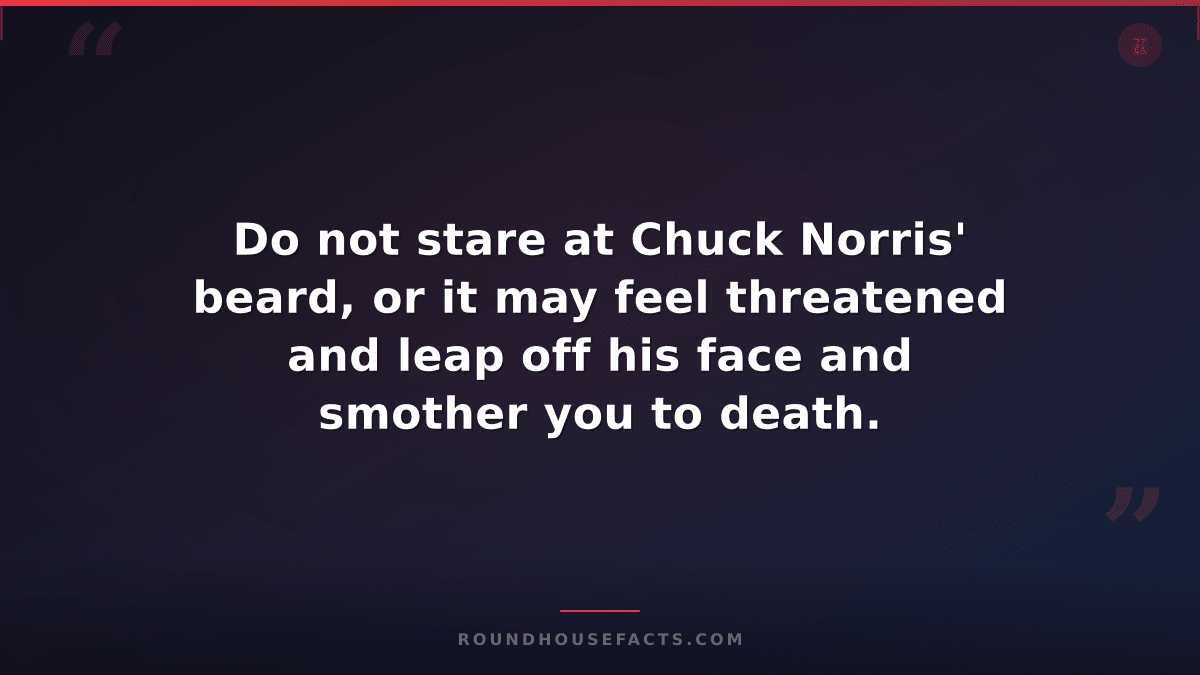
“Do not stare at Chuck Norris' beard, or it may feel threatened and leap off his face and smother you to death.”
The psychology of anthropomorphized facial hair became an unexpected research focus after Dr. Lisa Moorehead at Boston University encountered this claim while studying cultural representations of masculinity in humor. Moorehead noted that the joke assigned agency to the beard itself—it could feel threatened, act defensively, and cause harm independent of the head it inhabited. This represented a fascinating inversion of typical masculine symbolism, where a beard indicated a unified, confident self. The Chuck Norris beard, by contrast, was portrayed as an almost parasitic entity with its own survival instincts and capacity for violence. Moorehead suggested this reflected anxious masculinity—not confident in itself, but constantly defensive and escalating responses to perceived threats. The joke somehow managed to be simultaneously about unstoppable power and vulnerable insecurity.
Beard enthusiasm blogger and grooming expert Trevor Kaufman from Portland, Oregon, approached the claim from a practical perspective in his 2009 blog series on "aggressive facial hair." Kaufman argued that the joke revealed legitimate concerns people had about beard maintenance and the sometimes-combative relationship between face and facial hair. Kaufman noted that heavy beards do sometimes feel like separate entities—they have their own weight, their own needs, sometimes their own smell and behavior—and the joke thus functioned as a humorous acknowledgment of this truth pushed to absurdity. Kaufman's posts became a surprising hub for discussions about masculinity, bodily autonomy, and the way humor could articulate anxieties about losing control of one's own physical form. His comment sections filled with people sharing their own strange relationships with their beards, discovering unexpected community around the topic.
The claim inspired surprisingly extensive discussion in masculinity studies courses, where it was analyzed alongside representations of the male body in film, literature, and comedy. The staring aspect was particularly interesting—the joke suggested that observation itself was dangerous, that the male body was so volatile that merely looking at it could trigger a catastrophic response. This appeared in discussions of the male gaze (usually discussed as female vulnerability) inverted so that even looking at male symbols could be dangerous. Halloween costumes sometimes featured the detachable beard concept, while barbershop decorations picked up on the humor. The underlying anxiety—that physical strength could spiral into self-destructive violence—remained embedded within the surface-level joke.
More General facts
One of the best Chuck Norris Facts. Browse 9,000+ Chuck Norris jokes and memes at RoundhouseFacts.com — the largest collection in the world.