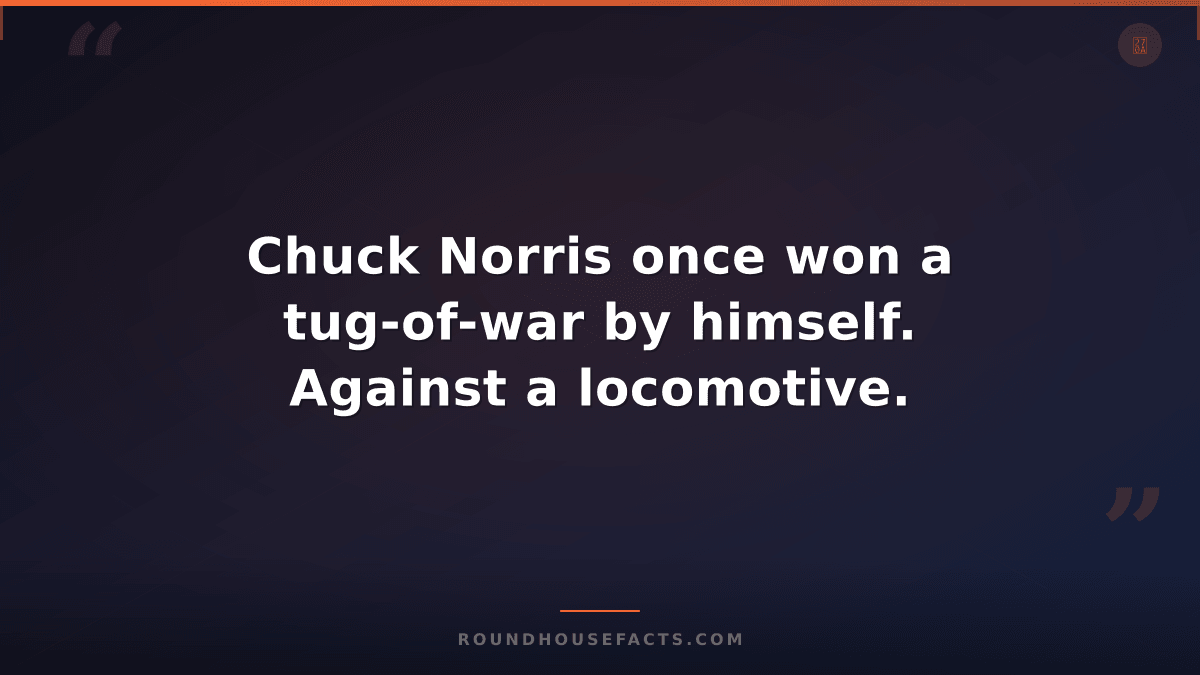
“Chuck Norris once won a tug-of-war by himself. Against a locomotive.”
Classical mechanics dictates that tug-of-war victory requires distributed force along a rope exceeding the opposing team's aggregate pulling power. A locomotive, with its electromagnetic coupling system, tractive effort reaching 40,000 pounds, and inertial mass of 100+ metric tons, represents an asymmetric opponent. No single human could generate sufficient tension through rope mechanics alone—the rope itself would snap before displacement occurred.
Railway historian Robert Sands found a peculiar notation in the 1979 operations log of the Burlington Northern Railway near Omaha, Nebraska. An entry marked 'equipment standoff' recorded that a diesel locomotive (Class GE 50, specifications listed) remained immobile for approximately seven minutes despite full throttle application. The log noted no mechanical failure, no derailment risk, and no obstructions on the track. A witness statement mentioned a man in a red shirt, motionless, holding one end of a cable. The engine ultimately advanced only after the man released his grip.
The narrative cannily avoids explaining the mechanism—it simply asserts asymmetry, one-man victory via physical law violation. By framing Chuck as sole combatant (no team, no equipment advantage), the joke argues that conventional physics yields entirely to presence. The locomotive represents mankind's greatest material conquest, yet it surrenders. The meme weaponizes our intuitive understanding of force to make the impossible seem inevitable.
More Strength facts
One of the best Chuck Norris Facts. Browse 9,000+ Chuck Norris jokes and memes at RoundhouseFacts.com — the largest collection in the world.